

The Diljit Dosanjh concert that became our classroom
We were supposed to post this yesterday. The day ran away from us, and honestly that’s fine, because a night like that deserves a proper write-up and not a rushed caption.
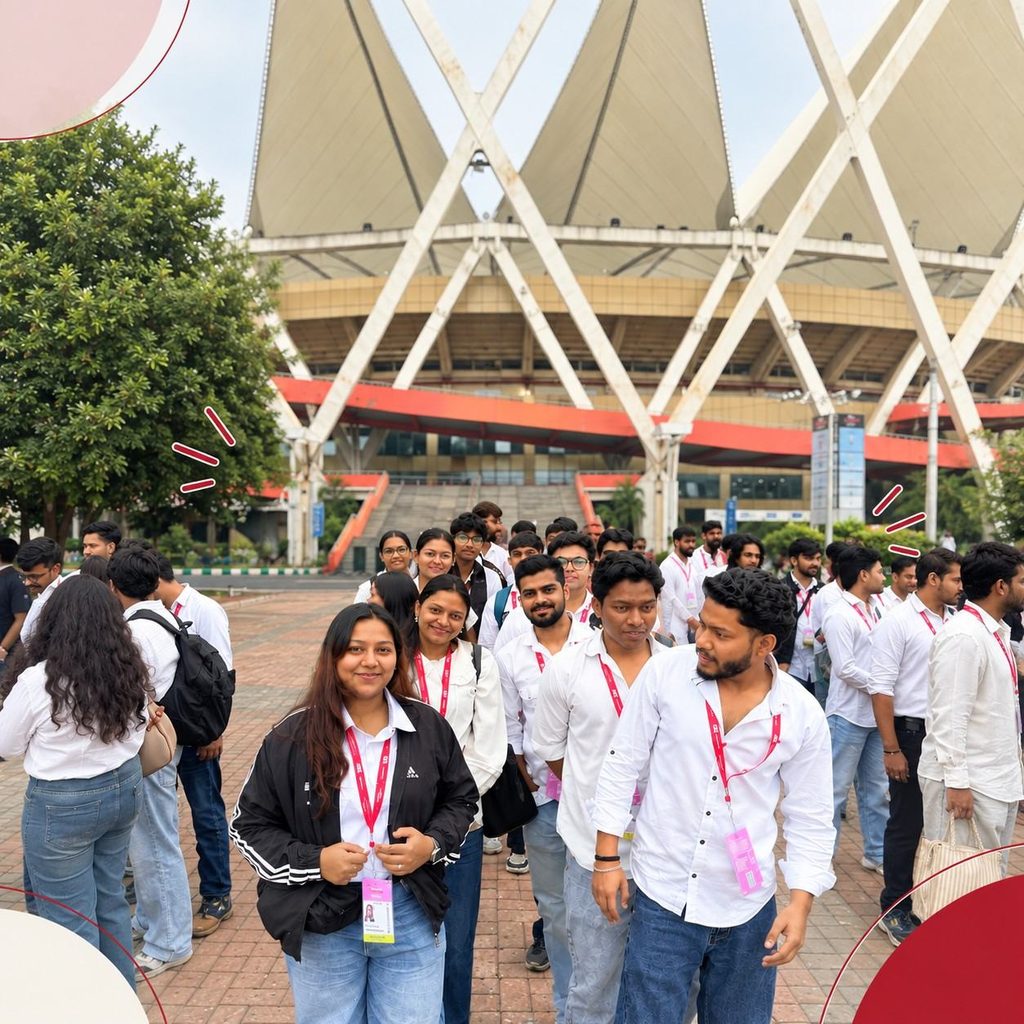
On 30 October, JLN Stadium in Delhi hosted the first stop of Diljit Dosanjh’s Aura India Tour, and Event University got the chance to take part in it. Not watch from a distance. Be part of it. Our students were inside, seeing how a big Diljit Dosanjh concert actually gets built, run and packed away, from the first barricade to the last light switching off.
If you’ve ever wondered what really happens behind a show of this size, this blog is for you. And if you’re thinking about a career in events, read it twice.
Why a classroom alone will never be enough
Event management is one of those fields where you can read every book and still freeze at your first live show. Theory tells you what a run sheet is. It doesn’t tell you how it feels when that run sheet falls apart an hour before the gates open and a long queue is already forming outside.
That’s why a good event management course can’t stay inside four walls. You do need the basics: budgeting, vendor handling, marketing, risk planning, guest experience. We teach all of it. But the real learning starts when those topics crash into each other on a live site. A late truck delays the sound check. The sound check delays the gates. The gates change the mood of the whole crowd. You only understand that chain once you’ve watched it happen.
So our event management course is built around one belief: you learn this job by standing where the job happens. Reading about crowd control is useful. Seeing a team handle it live is something else.
What our students saw at the Diljit concert
Most people experience a concert from the front. Lights, music, a voice they’ve known for years. Our students got to see the other side of the very same night.
They saw how the day starts hours before anyone with a ticket arrives. Teams walk the venue, test equipment, brief staff and confirm who stands where. They watched how entry gates are managed, how queues keep moving, how barricades shape the way a crowd flows, and how one calm instruction from a team lead can do more than a loud one. At a show this size, nobody can afford to stand around. Everyone has a task, a time and a person to report to.
And they saw something most textbooks cover badly: permissions. Before this Diljit concert, police permission for the Delhi show was briefly withheld, then cleared after organisers took officials through detailed security and crowd plans, as ThePrint reported. For a student, that’s a live lesson in why paperwork and planning matter as much as the stage and the sound.
Inside a big show: what keeps everything running
People call it concert management, but it’s really a hundred small jobs happening at the same time. These are the five things that stood out to us.
- Crowd flow. Entry, exit, food, washrooms and emergency routes are all decided on paper long before the first guest walks in. If the flow is wrong, no amount of great music fixes the mood.
- Communication. Radios, clear reporting lines, one person who knows the answer. When something goes wrong, the right person needs to know in seconds, not minutes.
- Safety and security. Checks at the gate, medical support, and a plan for the “what if” nobody wants to talk about.
- Vendors and production. Sound, lighting, stage, food counters. Everyone has to arrive on time and fit into one schedule.
- People. A show like this runs on staff and volunteers, and they need briefings, breaks and clear instructions to do a good job.
The funny thing about good concert management is that it’s mostly invisible. If the audience notices it, something has probably gone wrong. That quiet, unseen pride is what this career is about.
Lessons we hope every student carries home
Most event professionals will tell you they learned the job on site, not in a lecture. A Diljit Dosanjh concert is the kind of event that makes the basics obvious, so here’s what we hope our students took from it.
- Planning wins. The calmest shows are the ones that were over-prepared weeks earlier.
- Teamwork is the real product. Nobody runs a stadium alone. Every role, from the gate to the stage crew, matters.
- Stay professional, even when you’re excited. Follow instructions, respect the rules, and don’t do anything that makes you or the team look careless.
- Be useful before you try to be impressive. The volunteer who quietly solves problems is the one people remember.
- Stay calm. Panic spreads faster than any announcement. So does calm.
None of this can be memorised for an exam. You pick it up by being there, making small mistakes, and watching people who’ve done it a hundred times. That’s the whole idea behind the work we do.
Being part of a show is different from watching it
We didn’t organise the Diljit concert, and we won’t pretend we did. The organisers, the production crew and the venue teams ran the show. Our students took part in it, which turned out to be a great place to learn from. When you aren’t responsible for every decision, you get the space to watch how every decision gets made.
That’s a big difference from being a fan in the crowd. At the Delhi stop of the Aura India Tour, the same stadium held thousands of different experiences. A fan saw a performer. A student from our batch also saw schedules, signals, crowd movement and a large team staying in sync while the show kept moving.
It teaches humility too. At JLN Stadium you quickly see how many people it takes for a single song to start on time. Every role in that chain matters, from the person at the gate to the person at the sound desk. That’s a useful thing to learn before you ever run an event of your own.
And it teaches discipline. When you take part in an event like this, you follow the event team’s rules, you stay in your lane, and you don’t do anything that makes you or your institute look unprofessional. That’s exactly the habit this industry wants to see in someone new.
Why Event University is different
Let’s be honest about what we are. Event University isn’t a place where you sit through slides for a year and then get pushed into the industry. We teach the theory, but we put just as much weight on practical work, the kind that actually helps in real life.
Our event management course covers what you’d expect: planning, budgets, vendors, marketing, risk and guest experience. Then we take students to real events, so they see how concert management is done at a scale most people only ever watch from the crowd. They see the pressure, the teamwork and the problem solving up close.
That matters for a simple reason. Anyone can tell you how an event should run. It’s far more valuable to have seen one run, with your own eyes, on the ground. When you walk into an interview and can talk about taking part in the Diljit concert, you’re not repeating a textbook. You’re telling a story, and you’ll sound like it.
Here’s what that kind of learning gives you:
- Exposure to how real teams work on big events
- Confidence that comes from having been there, not just having read about it
- A clearer idea of which part of events you actually enjoy
- Stories and contacts you can’t get from notes
That’s what we mean when we say learn, create, execute. Our event management course is only where it starts.
Start before you feel ready
The Diljit Dosanjh concert is over, but what it started for our students isn’t. Somewhere in that crowd, someone who had never imagined managing something this big probably walked out thinking, I could do this.
If that’s you, here’s some honest advice: start before you feel ready. Volunteer. Show up early. Ask questions. Carry the box. Every great event professional began at some gate, holding a radio, a little nervous. From JLN Stadium to a college fest, every event runs on the same three things: planning, people and calm under pressure.
And if you couldn’t be there this time, don’t let that put you off. Watch how the best teams work, keep a notebook, and be ready when the next chance comes. The Aura India Tour is only getting started, and so are the students who learn by doing.
If you want to learn event management the way it’s really done, Event University is where you start. Message us to find out how.
Learn. Create. Execute.