
Event Management Career Guide 2026: Meaning, Courses, Salary & Scope in India
Most people picture an event management career as stage lights, celebrity guests and a headset. The real version often starts with someone standing at a venue gate at 6 a.m., waiting for a tent truck that was supposed to arrive an hour ago. Both pictures are true. Only one of them decides whether you will enjoy this job.
This guide covers what the work involves, what freshers actually earn, which course deserves your money, and how to land a first job without losing a year. Where sources disagree, I’ll say so.
Event Management Meaning and Definition: What the Job Really Is
Let’s start with the event management meaning in plain words. It is the work of planning, organising and running an event so the client enjoys a smooth day and never sees the scramble behind it.
The textbook event management definition is a little more formal: the complete process of planning, organising and executing an event within a set budget, timeline and set of client objectives. That’s accurate, but it misses the daily reality. You solve problems before anyone knows they exist.
The work usually runs in three stages:
- Before the event: Understanding what the client wants, building a budget, shortlisting venues, booking vendors and arranging permissions.
- During the event: Supervising setup, managing staff, keeping the schedule on track and dealing with whatever goes wrong. Something always does.
- After the event: Collecting feedback, clearing payments and noting what to do differently next time.
Take a wedding. Decor is just one piece. Someone also has to sort out catering, guest stays, airport pickups, music and photography, and all of it must happen at the right time. That someone is the event manager.
An event can be a wedding, a product launch, a conference, a college fest or a cricket tournament, and the core skills barely change. You plan backwards from a fixed date. You keep twenty vendors moving, each one convinced their delivery is the most important. You stay calm when the generator dies at 11 p.m. Plenty of people in the industry call it logistics wearing a party outfit, and they are not wrong.
Why Demand Is Real, Especially for Weddings
Weddings are the engine of this industry. The Confederation of All India Traders (CAIT) estimated around 46 lakh weddings between mid-November 2025 and mid-January 2026, with about ₹6.5 lakh crore spent in that window. The count was slightly lower than the year before, but spending per wedding went up. Destination weddings are growing too. WedMeGood’s 2025 report found that one in four Indian weddings is now a destination wedding, and about 90% of those happen inside India.
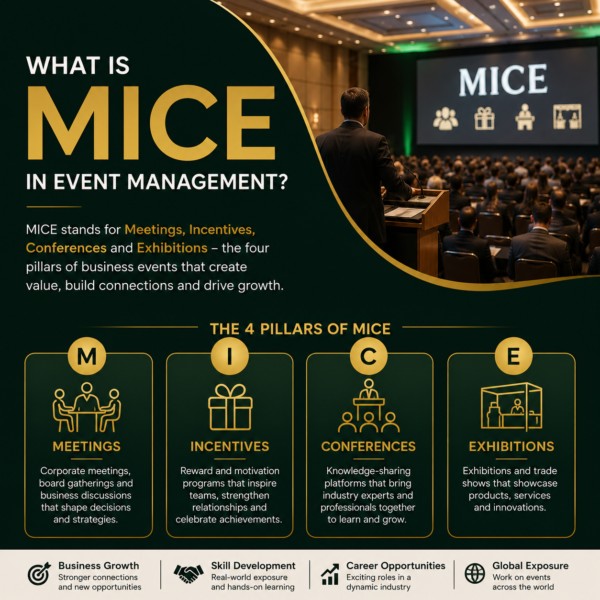
A family spending lakhs on a three-day celebration doesn’t want to coordinate hotels, decorators and transport alone, so it hires a professional. Corporate work such as conferences, dealer meets and product launches runs all year and fills the gaps between wedding seasons. A KPMG and Event and Entertainment Management Association (EEMA) report also lists MICE (meetings, incentives, conferences and exhibitions), sports, entertainment and cultural events as key segments.
There is a catch. Weekends are your workdays, and festival season is the hardest stretch. Deadlines are tight, clients change their minds, and last-minute chaos is normal. If you need a fixed routine, this field will test you.
Types of Events You Can Work On
Weddings and social events: Ceremonies, receptions, engagements and destination weddings. You handle venues, themes, guests, catering and vendors.
Corporate events: Conferences, seminars, product launches, award nights and company meetings. Clear communication, scheduling and budget control matter most.
Entertainment and live events: Concerts, music festivals, fashion shows and public performances. You coordinate artists, production crews and technical staff.
Exhibitions and trade shows: These bring businesses and buyers together. You plan stall layouts, manage exhibitors and look after visitors.
Event Management Career Salary: What Freshers Really Earn
This is where most guides get dishonest, so let’s slow down. Some institute blogs promise ₹6 to 12 lakh starting packages. Independent data tells a quieter story. Indeed’s figure from February 2026 puts the average event manager at about ₹28,977 a month, though that is built on just 22 salaries. Junior roles average closer to ₹18,000.
Most careful salary guides place freshers between ₹2.5 and ₹4.5 lakh a year, with metros at the upper end. A realistic first-year expectation is ₹20,000 to ₹40,000 a month at an agency. With three to six years behind you, published ranges for event managers sit around ₹6 to 10 lakh, and heads of department at large agencies can cross ₹12 lakh.
Freelance wedding planners are paid differently. Fees of ₹50,000 to ₹2 lakh per wedding are commonly quoted, depending on size and services. That’s real money, but it only arrives after you’ve built a reputation, and some months bring nothing. Peak-season overtime and project fees can add another 10 to 20% to a salaried person’s year.
A simple rule: if a page promises a ₹10 lakh job after a six-month course, you’re reading a sales page.
Which Course Should You Pick?
You don’t need a licence, and for wedding planning a degree isn’t compulsory. Employers care about reliability. A course gives you structure, vocabulary and contacts, but it doesn’t replace working real events. Here is how the options compare.
Short certificate or diploma. The cheapest way to test your interest. Vskills lists its online certification at ₹3,499, and Great Learning offers a free course where only the certificate costs extra. Good for a first taste, but not enough to get hired on its own. A decent diploma should cover planning, budgeting, venues, vendor handling, marketing and on-ground work.
Wedding management course. Worth it if weddings are your lane. A good wedding management course covers themes, venue selection, decor and stage planning, catering, vendor negotiation, budgets and destination wedding logistics, and it usually runs under a year. Ask whether it includes live events or an internship. If it doesn’t, keep looking.
PG diploma in event management. Aimed at graduates who want a quick, practical entry. A PG diploma in event management may cover advanced planning, operations, corporate communication, sponsorships, production and client handling. Its value depends on internships and placement support, so ask for the names of recent employers instead of trusting the brochure. Also check duration, recognition and syllabus before you pay.
MBA in event management. An MBA in event management usually runs two years across four semesters and is offered by more than 15 institutes in India. It leans towards the business side: marketing, finance, strategy, leadership and operations. Choose it if you’re aiming at agency leadership, brand partnerships or corporate events, and only at a college with a real industry network. From a weak institute it costs a lot and opens few doors. You also don’t need an MBA for every job here. A record of well-run events counts for a lot.
Online event management course. An online event management course is best for working people and students in smaller towns, since you can learn planning, budgeting and coordination at your own pace. Before paying, check who issues the certificate, who teaches, and whether there’s any practical component. AAFT Online, for instance, advertises a one-year diploma with NSDC and CII certification. Recorded lectures alone won’t prepare you for the pressure of a live event. A certificate with no live experience behind it is just a PDF.
A quick way to decide:
- Not sure about the field? Take a short or online course and crew three events.
- Love weddings? Join a wedding course and assist a planner for one season.
- Graduate aiming at corporate work? Go for a PG diploma, or an MBA if time and budget allow.
The Free Route Nobody Advertises
The industry’s real entrance is not a classroom. It is an actual event. Volunteer at your college fest, offer to help a local wedding planner, or crew a corporate function. Three events where you turn up on time, stay till teardown and stay calm will do more for your CV than most certificates.
Here’s a plan you can start this month:
- Work three real events in any role, even carrying boxes.
- Pick an event you attended and write its run-sheet: every task, who owned it and the time slot.
- Build a vendor list for your city: tent house, sound, decor, caterer, photographer, with contact notes.
- Apply as a coordinator or trainee at an agency or wedding planner.
- After a year, choose a lane: weddings, corporate, production or client servicing.
Many planners who run their own companies today learned costing, contracts and crisis handling inside someone else’s agency first.
Career Opportunities After Event Management
| Job role | What they do |
| Event Coordinator | Manages schedules, vendors and arrangements |
| Event Planner | Develops event concepts and planning strategy |
| Wedding Planner | Organises wedding functions and related services |
| Event Executive | Supports day-to-day event operations |
| Corporate Event Manager | Handles conferences and business events |
| Event Producer | Oversees production and execution |
You can work with event management companies, hotels, wedding planning agencies, entertainment businesses, corporates or exhibition organisers. Some people eventually go independent, once they have a trusted vendor network and a few happy clients.
Skills That Get You Promoted Faster
Coordinators who get bigger events share a few habits:
- Clean budgeting. Clients now expect itemised quotes, and comparing vendor quotations is a daily job.
- Vendor follow-up. They chase until a delivery is confirmed, not just promised.
- Written run-sheets. A run-sheet is the first thing they reach for.
- Clear communication under pressure. Client-facing work is won or lost here.
- Calm problem-solving. Equipment fails, rain shows up, deliveries arrive late.
- Teamwork. Many people work towards one deadline, and the event only works if they work together.
Content skills help too. Every event now doubles as a shoot, so planning plus decent reel footage is useful from day one.
How to Choose the Right Course
Don’t decide on fees or placement promises alone. Ask:
- Curriculum: Does it cover planning, budgeting, marketing, logistics and execution?
- Practical exposure: Will you work on live events or real projects?
- Faculty: Have the trainers actually run events?
- Career support: Are there internships, placement help or industry contacts?
- Fit: Does it match your qualification and where you want to go?
The best course isn’t the longest or the costliest. It’s the one that gives you skills you can use at work.
Is This Career Right for You?
Ask yourself three questions. Do you enjoy organising other people’s plans? Can you stay patient when something goes wrong at the worst possible moment? Are you fine working while everyone else is celebrating?
If the answers are yes, this is one of the few careers where you can start small, learn on the job and grow into your own business. If you want more predictability, aim for corporate and exhibition work, which tends to run more on weekdays than weddings do.
Knowing how an event should look is the easy part. The real skill is making every moving part work together on the day.