
A classroom can teach you the fundamentals of event management. But those lessons only really click once you step into the industry and see them play out in real time.
That’s exactly why an industry visit matters so much for students.
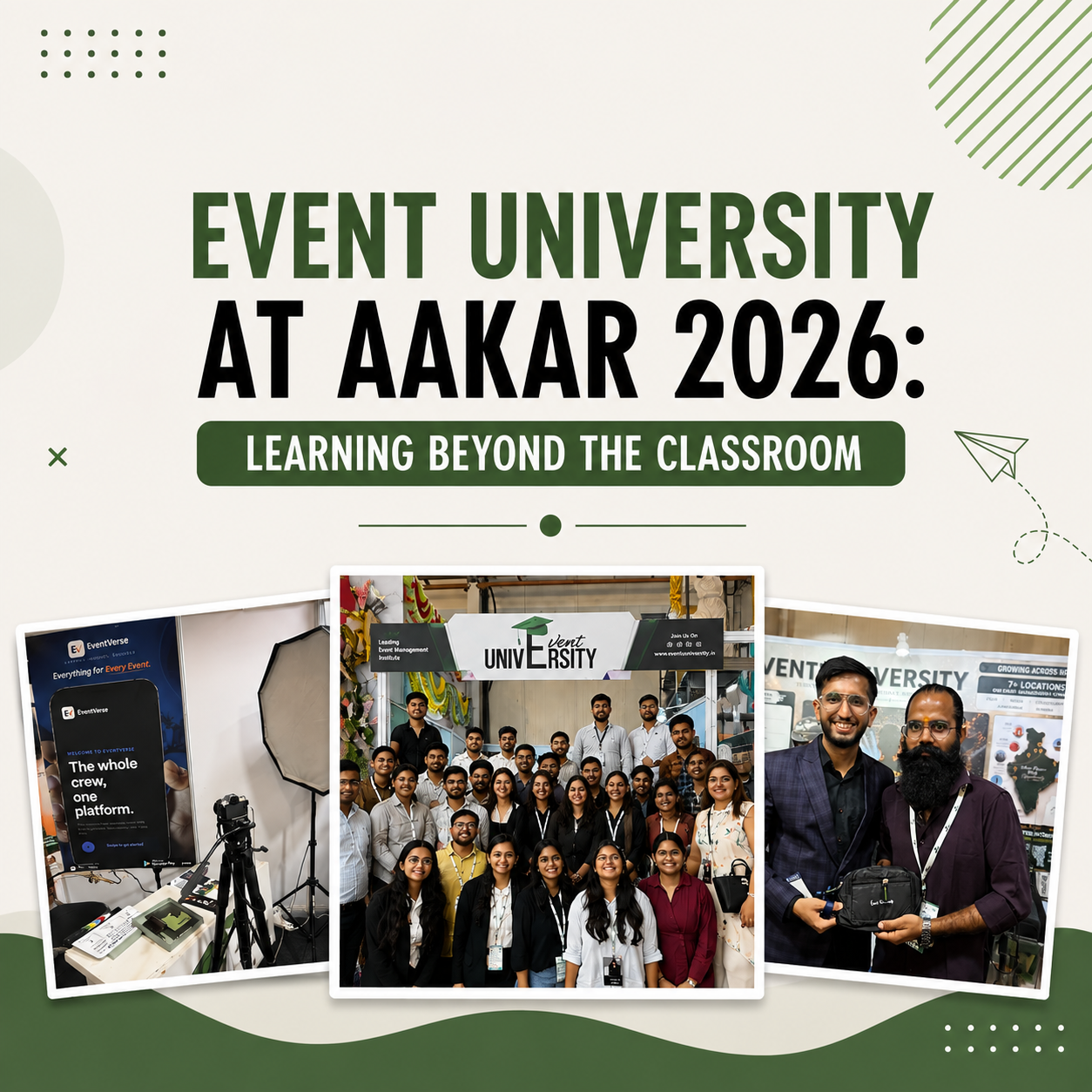
In August 2026, students from Event University visited Aakar 2026 at India Expo Mart, Greater Noida — one of the event industry’s major B2B exhibitions. It gave them a firsthand look at the businesses, products and technologies that go into building an event from the ground up.
Held from 19 to 22 August 2026, Aakar brought together four specialised exhibitions under one roof: event décor and infrastructure, hospitality, HORECA, and professional sound, light and entertainment technology. For Event University students, this wasn’t just another campus outing — it was a chance to see the event industry from a far more practical angle than any lecture could offer.
Aakar 2026: A Closer Look at the Event Industry
Aakar is built as a B2B platform, bringing manufacturers, suppliers, buyers and industry professionals onto one floor.
The 2026 edition combined Tent Decor Asia, HORECA Asia, Hospitality Asia and Sound & Light Asia — covering everything from wedding décor, tents and event infrastructure to hospitality solutions, professional audio, lighting, LED technology and staging.
For students, seeing that range in one place is genuinely useful. Most people only experience the finished product of an event — the stage, the lighting, the décor, the hospitality. What they don’t see is everything that happens before a single guest walks in: sourcing suppliers, coordinating teams, arranging equipment, managing timelines, and making a hundred small decisions along the way. Aakar gave students a much clearer view of that entire ecosystem.
Why Event Industry Exposure Matters
You can’t fully learn event management from a textbook. Planning an event on paper looks nothing like watching suppliers, technology providers and production teams actually work together in a live setting.
An industry visit helps students connect what they’ve studied in class to what actually happens in the market. A lesson on event production suddenly makes more sense once you’ve stood in front of professional staging and AV setups. Vendor management feels a lot more real once you see just how many suppliers are involved in pulling off a single event. Even something like event décor looks different once you understand the materials, infrastructure and execution work sitting behind that final design.
This is where classroom learning and real industry exposure start to meet — and that’s the actual value of a visit like this.
Seeing the Business Behind the Experience
Aakar 2026 wasn’t just booths and product displays. It brought together businesses working across nearly every part of the events, hospitality and entertainment ecosystem — wedding and event decorators, rental companies, caterers, stage and mandap providers, lighting suppliers, event infrastructure firms, AV businesses, and other specialists, as listed in the official exhibitor profile.
For someone starting out in events, seeing this range can genuinely shift how you think about the industry. A wedding, a corporate event, or an exhibition might look like one seamless experience to a guest. Behind the scenes, though, it’s usually several independent teams working towards that same outcome. Understanding that network — who does what, and how it all comes together — is a big part of becoming a capable event professional.
Exploring Event Technology
Technology plays a much bigger role in modern events than people realise. Lighting sets the mood. Sound shapes how an audience experiences a moment. LED screens can completely transform a stage. Staging systems make large-scale productions possible in the first place.
Aakar’s Sound & Light segment focused on exactly this — professional audio, visual, lighting, LED, staging and entertainment technology used across live events.
Students don’t need to become technical experts overnight, but a future event manager does need to understand enough about production technology to hold a proper conversation with technical teams, talk requirements through with clients, and make sound calls during planning. That’s not something you pick up from theory alone — it needs exposure.
Learning From the People Behind the Industry
At its core, the event industry runs on people. Planners work with vendors. Production teams work with designers. Clients work with agencies. Technical teams coordinate closely with organisers. Communication is really what ties all of it together.
Aakar’s visitor profile included event planners, wedding planners, rental companies, production houses, sound engineers, lighting designers and AV professionals — putting students in an environment where all these roles were visible at once. That kind of exposure also nudges students to ask sharper questions about their own future in the industry: Do I enjoy planning more than production? Would I rather work on weddings, corporate events or exhibitions? Am I drawn to creative work, client servicing, or technical execution?
Sometimes it takes an experience like Aakar for students to find those answers earlier than they expected.
Connecting Learning With Real-World Experience
Event University’s teaching approach leans heavily on practical exposure — live projects, industry mentorship, market visits and real event experience are all part of how students learn here, and the Aakar visit fits right into that model.
Instead of just discussing the event industry in class, students got to observe it directly. Instead of reading about suppliers, they walked among them. Instead of treating event technology as a chapter in a textbook, they saw exactly how it shapes the final event experience. That’s really the difference between knowing what vendor management means on paper, and understanding why vendor relationships, communication and execution actually matter when an event is being delivered live.
What Students Can Take Away From Aakar 2026
An industry visit rarely boils down to one single takeaway — its real value is in giving students a wider picture of the field they’re entering. From Aakar 2026, students had the chance to explore:
- Event infrastructure and décor solutions
- Sound and lighting technology
- Stage and production systems
- Hospitality and catering solutions
- Vendor and supplier networks
- Industry trends and new products
- Professional networking
- Different career paths within events
Aakar also included product demonstrations, industry seminars, workshops and networking sessions — making it feel more like a professional working environment than a typical public exhibition. That distinction matters, because it gave students a chance to observe the industry as it actually operates, not just as it’s presented to visitors.
Why Practical Experience Matters for Future Event Professionals
The event industry doesn’t stand still. Client expectations shift, technology keeps evolving, event formats change, new production solutions show up constantly, and audiences increasingly expect experiences that feel personal and engaging.
That means a future event professional needs more than creativity alone — communication skills, organisation, problem-solving, teamwork, and a real understanding of how the different pieces of an event fit together all matter just as much. Practical experiences like this build exactly that kind of perspective, and they make classroom discussions land differently too. Once you’ve seen something in the real world, the concept behind it becomes a lot easier to understand and remember.
From Aakar 2026 to the Next Event
A career in events is built one experience at a time. A classroom lays the foundation. A live project builds responsibility. An internship introduces professional expectations. And industry visits like this one show students the larger ecosystem they’re preparing to step into.
The Aakar 2026 visit gave Event University students exactly that — a firsthand look at an industry built on far more than creative ideas alone. Behind every successful event are people, suppliers, technology, planning and execution, all working together.
Learning Beyond the Classroom
The most valuable education doesn’t always happen behind a desk. Sometimes it happens while standing in front of a new production setup, watching how a supplier operates, listening in on an industry conversation, or simply taking in the scale of the business you’re hoping to join.
Event University at Aakar 2026 gave students exactly that opportunity — stepping into a real industry environment, connecting their classroom learning with the wider events ecosystem, and getting a clearer picture of everything that goes into creating a professional event.
Because learning event management isn’t just about knowing how an event should be planned. It’s about understanding how that plan actually comes to life.