
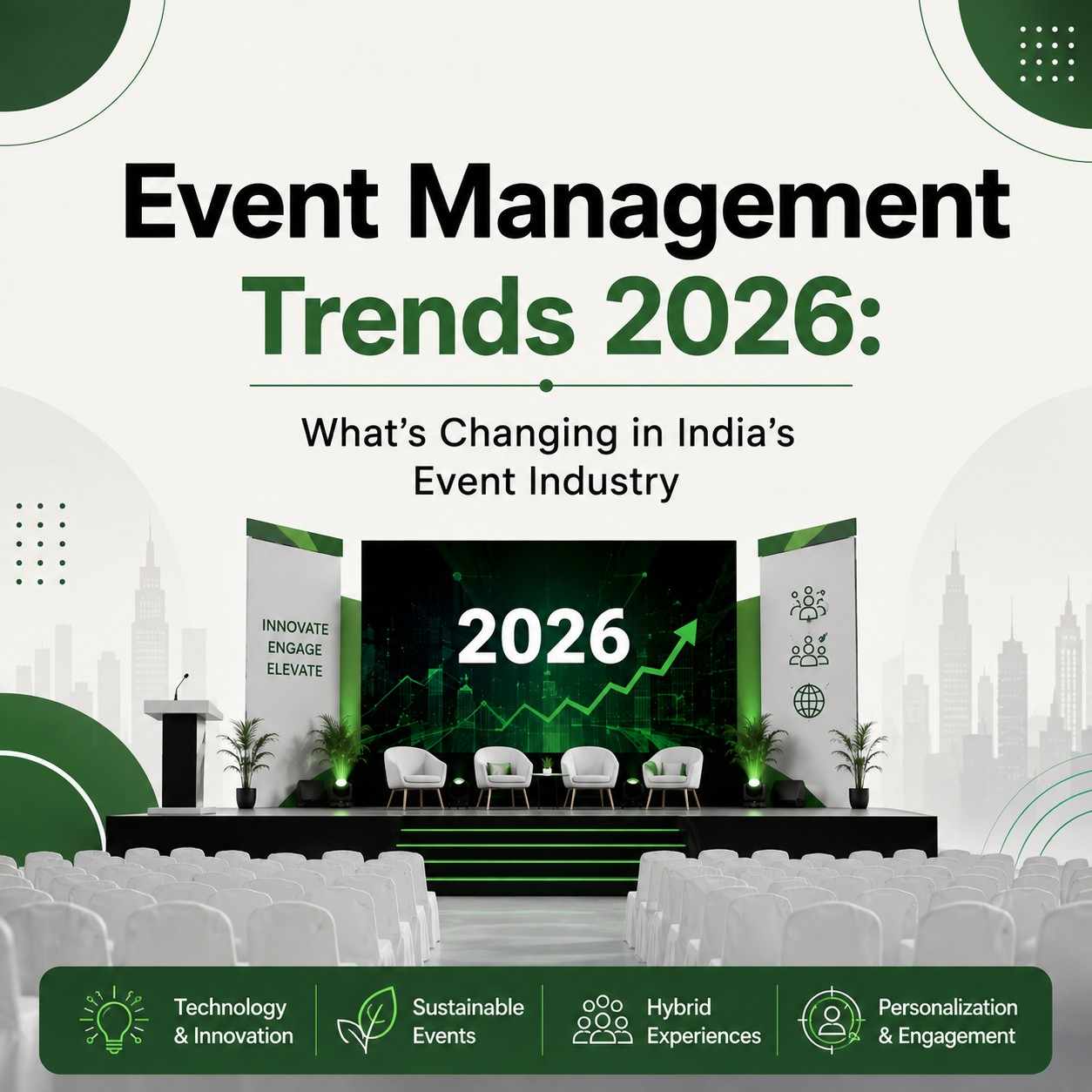
Event Management Trends in India: What’s Changing in 2026
Walk into any wedding, brand launch or concert in India right now and you’ll notice the same thing. People don’t want to just attend anymore. They want to join in, click photos and leave with something to talk about. That’s why the latest event management trends matter, whether you plan events, buy them for your brand, or are still working out if event management as a career is for you. Event industry trends used to shift slowly. Lately, they haven’t.
The numbers back this up. EY-Parthenon and BookMyShow’s March 2026 report, Beyond Attention. Into Immersion, puts India’s live events market at about ₹13,000 crore. It also found that 78% of Indian consumers would rather spend on experiences than products. Put simply, the events that work are built around what people feel and do, not just what they see.
People come for the experience, not the agenda
The most significant among the current trends in event planning is the departure from fixed formats. Now you need a real reason for people to want to come to a conference, launch or concert so planners are leaning on storytelling, themed spaces, unique touches, and things guests can actually do.
What used to mean speeches and dinner for a corporate event might now mean live demos, small group networking and branded installations. Weddings, too, are going through the same thing, families want ideas that feel like them. Instead of treating all guests equally, the organizers are personalizing invitations, recommendations and networking. It places creativity at the heart of the event planning business. You need to know who is attending and why, before you even select a venue or a theme.
AI works best when guests never notice it
AI is on every list of the latest trends in event planning, but 2026 is less about hype and more about day-to-day use. It helps planners understand audience preferences, personalize messages, write content and accelerate registration. FCM Meetings & Events’ trends report found planners across Asia-Pacific are taking note of AI, AR/VR and pre- and post-event media.
The question is whether it’s solving a real problem.” Nobody buys a ticket because the registration form is clever. They see entry is fast. That’s where AI earns its keep. The planner of the future will need creative instinct and enough technical comfort to use these tools without being run by them.
Brands want to be part of the moment
People expect events to feel relevant to them, and for brands that changes the job. A logo on a backdrop doesn’t do much anymore. In the EY-Parthenon and BookMyShow survey of 7,450 attendees, 63% said brands improved their overall experience, 59% remembered the brands they met on the ground, and 55% said they were more likely to buy afterwards.
That’s why trends in event marketing are moving towards participation and real connection. More than half of the brands in the report’s CMO survey ran experiential activations last year, and most plan to continue in a more structured way. Those who haven’t started mostly blame lack of expertise (71%), budget (57%) and measurement (43%), which is exactly where skilled event professionals fit in.
Smaller, closer and beyond the metros
Among the corporate event trends worth watching, the move beyond the big cities is the most India-specific. An RX Global trends briefing says tier-II cities now contribute 35-40% of domestic MICE activity, and FCM expects places like Rajasthan to draw more corporate events. Hybrid formats have also become a long-term tool rather than a pandemic workaround.
Corporate events are also competing harder for attention. The FICCI-EY Media & Entertainment Report 2025 found they were still 58% of all events, but the lowest share since 2015, as ticketed concerts and sports grew fast. A warning, though: smaller doesn’t mean easier, since several small events can mean more coordination, not less.
Immersive tech, with a purpose
LED screens, projection mapping, interactive installations and AR can turn an ordinary hall into somewhere unrecognisable. But the tech works best when it supports the idea rather than becoming the idea. A stunning installation gets attention, and then guests ask what it was for. Creative planning and technical execution have to be worked out together. It’s one more reason event management trends keep pointing towards experience: audiences want something they can’t get from a screen at home.
Green is turning into a requirement
Large events create a lot of waste through food, décor, packaging and temporary builds. ITB Asia reports that 88% of corporate business travellers prefer sustainability-conscious event partners, and in May 2026 Radisson Bengaluru City Center hosted a round table on green meetings with planners, hotels and wedding stakeholders. None of this means rebuilding every event from scratch. Reusable décor, fewer single-use items, digital invitations and local suppliers all help, and food-waste planning is an easy first win. Among event industry trends, this one has moved from nice-to-have to something companies check before they book.
Safety and permissions are part of the plan now
India’s live-event boom had a rough first half of 2026. The Hollywood Reporter India notes a string of cancellations and crowd-safety incidents that pushed the industry to take regulation more seriously, and the EY-Parthenon and BookMyShow study of Coldplay’s Ahmedabad shows points to unified clearances as one way forward. For planners, crowd management, permissions and emergency plans belong in the concept from day one, not at the end. They are becoming a real mark of a professional planner.
Events keep working after the event ends
A live experience can build awareness, create content and grow a community, and it keeps working online through social posts, creator videos and conversations long after the day itself. That’s why event marketing trends focus on the whole audience journey: promotion before, engagement during, content afterwards. Marketers are starting to see an event as a campaign with several touchpoints, not a single day. The scale is there too, with over 30,000 live events across 300 Indian cities in 2024, according to BookMyShow data in the EY report.
What this means for people entering the field
The biggest takeaway from the trends in event planning industry-wide is that event management isn’t just about booking venues, coordinating vendors, and keeping the show on time. Now planners also have to learn about technology, marketing, audience behavior, budgeting, safety and data.
It opens up opportunities for students considering a career in event management in the fields of weddings, corporate events, concerts, exhibitions, MICE, brand activations and festivals. The industry needs people who can take an idea, run it well and deliver it on the ground.
Conclusion
Event Management Trends Shaping India in 2026: A More Experience-led and More Responsible Industry The fundamentals remain unchanged: know your audience, create a compelling idea, and execute it with care. The planners and brands who will be remembered are those who stay on top of event marketing trends and the rest of this list, and who marry creativity and technical skills.