
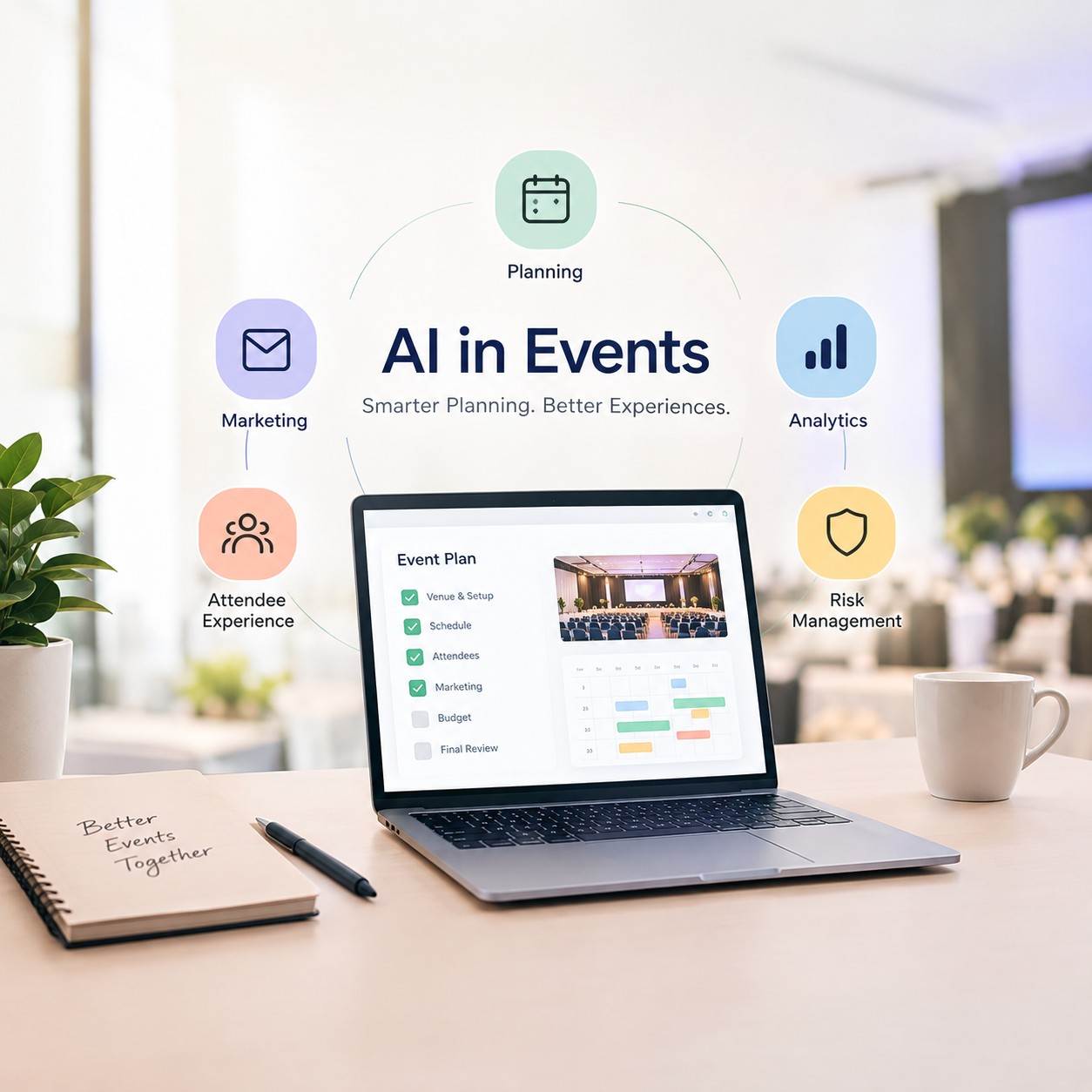
Artificial intelligence is no longer just a technology topic for software teams. It is becoming part of how events are researched, planned, promoted, delivered, and evaluated. For event professionals, the opportunity is not to hand an event to a machine. An AI event planner can handle repeatable work without replacing the person responsible.
Recent industry research shows why the conversation has moved beyond hype. Momentus reports that 64% of venue operators consider AI highly significant to venue and event management, while only 7% are actively piloting or scaling AI use cases. The gap shows that interest is strong, but practical adoption is still developing. The priority is understanding where AI works, where supervision is needed, and how it fits an existing workflow.
What Is AI in Events?
AI in events refers to the use of artificial intelligence to support tasks across the event lifecycle, from the first planning brief to post-event analysis. Depending on the platform, AI can help organize information, generate first drafts, identify patterns in data, personalize communication, recommend actions, and automate parts of a workflow.
AI is not a replacement for event strategy. Planners still own the audience, budget, venue, suppliers, schedule, risks, and experience. AI is most useful when it handles repetitive or data-heavy work while people retain judgment and accountability.
How AI Is Being Used in Event Planning
The simplest starting point is planning documentation. An event team can use AI to turn a brief into a working structure for objectives, audience requirements, session ideas, timelines, communication tasks, and follow-ups. It can also help draft speaker outreach, attendee emails, event descriptions, FAQs, social posts, and internal notes.
An AI event planner connected to venue, schedule, guest, or operational data can produce more useful recommendations than a general chatbot. Event technology is also moving toward venue sourcing, registration, networking, analytics, and content workflows.
Scheduling is another practical use. Event teams regularly balance speakers, sessions, rooms, breaks, setup periods, staffing, and attendee movement. AI can help identify conflicts and suggest alternatives, but the final schedule still needs human review because real events contain constraints that are not always visible in structured data.
AI can also support attendee communication. Instead of sending the same message to everyone, organizers can use available attendee information to make communication more relevant, such as reminders based on registration status or information related to sessions and interests.
AI for Events Marketing and Attendee Experience
Marketing is one of the areas where AI can provide immediate productivity benefits. Teams can use it for campaign variations, audience research summaries, email sequences, channel-specific messaging, and content repurposing.
Good event marketing still depends on strategy. AI can generate multiple messages quickly, but it cannot automatically decide which promise is credible for a specific audience or whether the brand voice feels right. Human review remains essential.
The same principle applies to attendee experience. AI for events can support chatbots, FAQs, session recommendations, networking suggestions, and personalized content. Eventbrite describes similar uses across logistics, scheduling, resource allocation, networking, and post-event reporting. These applications can remove friction without removing the human side of an event.
During an event, AI can summarize sessions, surface common attendee questions, organize operational information, and flag issues that need attention. More advanced systems may connect multiple workflows and help teams respond faster when circumstances change.
Where Event AI Delivers the Most Value
The strongest business case for event AI is not full automation. It is shorter repetitive processes and better access to information for decisions.
Post-event reporting often requires survey comments, attendance figures, engagement information, notes, and campaign results. AI can summarize this material and identify recurring themes, helping teams move faster from raw information to useful questions.
Resource planning can also benefit. Historical event information can reveal booking patterns, room usage, staffing needs, and other operational signals. AI may help identify patterns or support forecasting, but predictions depend on data quality and should not be treated as facts.
Risk management also benefits from a structured approach. AI can help review previous incidents and recurring operational issues, but safety decisions should remain under appropriate human control when the consequences of an error are significant.
This is an important distinction because the most valuable applications are not always the most visible. Generating an attractive event description may save minutes, while improving how a team finds information, detects a scheduling conflict, or prepares an operational report can create value throughout the event lifecycle.
Generic AI vs Purpose-Built AI
A major distinction is between general-purpose AI and event-focused systems. General AI assistants are useful for brainstorming, drafting, summarizing, and transforming information, but they are not automatically aware of venue capacity, booking history, staffing, policies, or live conditions.
Purpose-built event AI can be more valuable when it is connected to the systems and data that an event team already uses. Momentus’ 2026 research found that 52% of venue operators identified a lack of domain-specific venue knowledge as the primary gap in AI tools they had tried. The finding points to an important lesson: the quality of an AI result depends not only on the model, but also on the context it can access.
This is where event planning AI becomes useful: organizations should evaluate AI by workflow. Ask what data the system can use, what actions it can take, how results are checked, and how easily it fits existing processes.
The Human Role Still Matters
The growth of event planning AI does not make human professionals less important; it makes their judgment more valuable.
Events involve relationships, negotiations, cultural expectations, unexpected changes, and decisions made under pressure. These are not simply data-processing problems.
The best model is human-AI collaboration. AI prepares information, identifies patterns, creates drafts, and automates repeatable steps. The professional provides context, checks accuracy, approves decisions, and owns the outcome.
That human role is particularly important during live events. A speaker may cancel, a supplier may arrive late, a room may need to change, or an attendee may have a problem that does not fit any predefined workflow. Technology can help a team respond, but experience determines how the situation should actually be handled.
Challenges of Using AI in Event Management
The biggest challenge is trust. Event teams may handle attendee details, preferences, business information, or confidential client material. Before introducing an AI system, organizations should understand where data is stored, who can access it, how it is processed, and what controls exist.
Accuracy is equally important. AI can produce convincing but incorrect information, especially around venue details, schedules, pricing, policies, accessibility, and attendee communications. Important facts therefore need human verification.
Integration can also be difficult. If a tool creates another isolated database or requires staff to copy information between systems, its efficiency may disappear. Identify one or two repetitive workflows, test them, measure the result, and expand only when useful.
These concerns are reflected in current industry research. Momentus reports that security and data privacy are among the leading barriers to AI adoption, followed by trust in AI-generated decisions and integration with existing workflows.
How to Start Using AI for Events
Organizations do not need to automate an entire event to begin. Start with a repetitive, measurable, low-risk process such as drafting internal documents, summarizing meetings, preparing attendee communications, or organizing feedback.
Next, create clear review rules. Decide which AI outputs can be used as drafts and which require approval before they reach a client, vendor, speaker, or attendee. Keep sensitive information out of tools that have not been approved for that type of data.
For long-term capability, training matters as much as software. An event management course that includes AI workflows can help professionals connect traditional event fundamentals with new technology. The goal is combining planning judgment, operations, data, and AI responsibly.
This is particularly relevant for new event professionals because understanding AI should not come at the expense of learning core event skills. Budgeting, vendor management, client communication, venue operations, production, guest experience, and contingency planning remain fundamental. AI becomes more useful when the person using it understands the work it is supporting.
The Future of Event Technology
The next phase is likely to move from isolated content generation toward connected workflows. Instead of writing one email, AI systems will increasingly be expected to understand event context, surface information, flag conflicts, and assist with multi-step tasks.
That does not mean every event will become fully automated. A more realistic future is one where routine work happens faster while professionals spend more time on strategy, creativity, relationships, and live decisions.
Current event technology already points in this direction. Cvent, for example, describes AI applications spanning event marketing and planning, while newer event platforms are exploring AI across attendee engagement, operational workflows, and event intelligence.
For event organizations, the competitive advantage will not come simply from saying they use AI. It will come from knowing where AI genuinely improves the work, having trustworthy data behind it, and putting the right human checks around it.
Conclusion
AI in events is becoming a practical part of modern event management, but its value depends on how thoughtfully it is used. From planning and marketing to attendee communication, reporting, resource management, and operational insight, AI can reduce repetitive work and help teams act on information faster.
The strongest results come from treating AI as an assistant rather than an autopilot. Choose clear use cases, use reliable data, protect sensitive information, verify important outputs, and keep experienced event professionals in control of decisions that affect people and the event experience.
For planners willing to take that balanced approach, AI can become a useful layer of the event workflow while keeping the human experience at the center.