
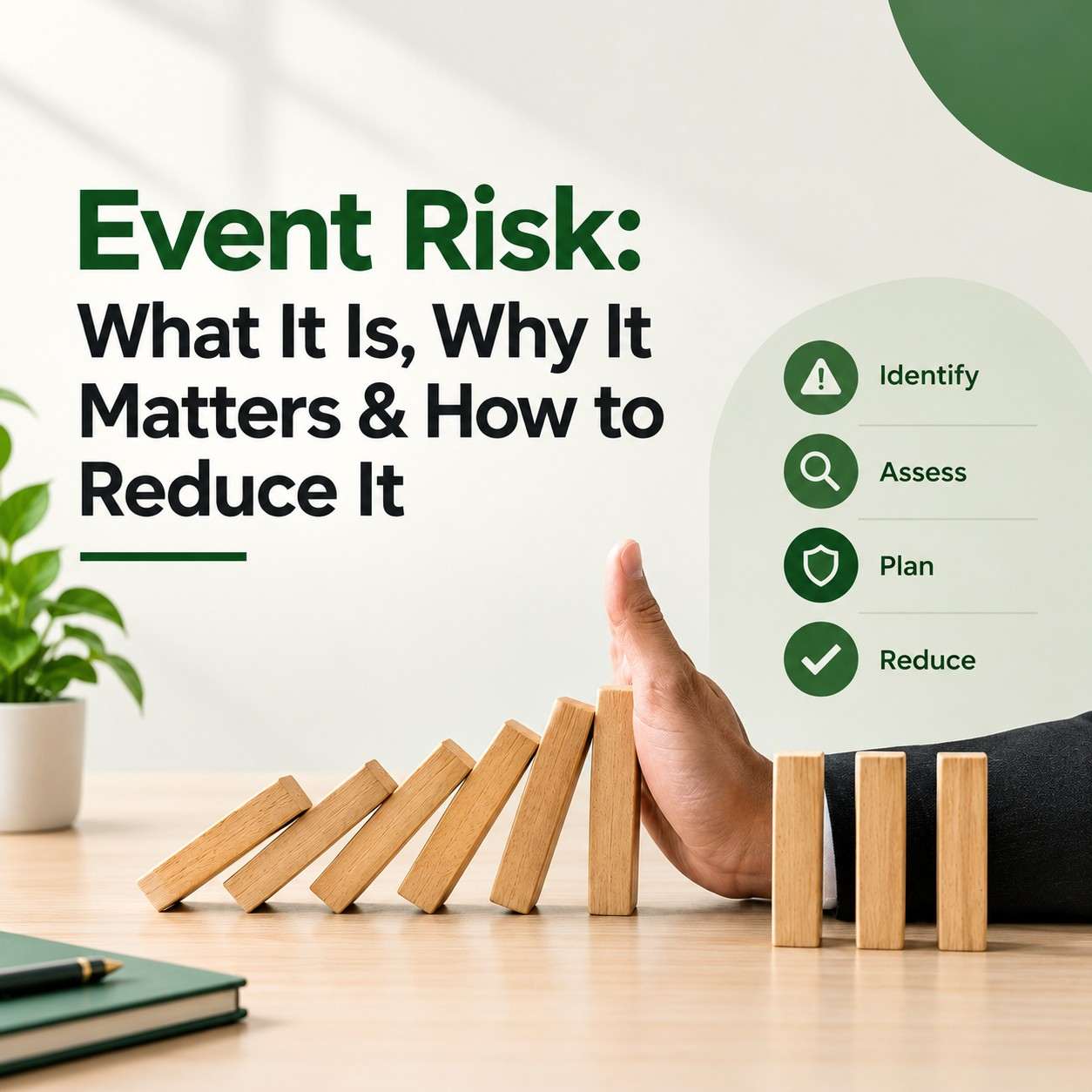
What Is Event Risk, in Plain Words?
If you are wondering what is event risk, the short answer is this: it is anything that can go wrong and hurt your event, your budget, your people or your name. A sudden rain at an outdoor launch. A caterer who never turns up. A gate built for 300 people and 500 people standing in front of it. All of that is event risk.
Now comes the part most people mix up. A risk is something that might happen. A risk event is something that did happen. Here is a simple risk event definition: it is a real incident or a close call that causes a loss, and sometimes a gain, and is serious enough to be written down and studied.
So what is a risk event in real life? It is not only big disasters. A generator that failed during rehearsal but worked on show day counts. An artist who landed two hours late counts. A guest who slipped on a wet floor counts. Even a lucky surprise counts, like a change in weather that pushed double the walk-ins into your indoor hall. You still want to know why it happened, so you can either repeat it or be ready for it.
Why Event Risk Needs Your Attention
Events are one-shot work. There is no second take. You spend money before the first ticket sells, depend on ten different vendors, and keep real people in one space for hours. If something breaks, you fix it live, with everyone watching.
That is why risk events pile up quietly in the background. A late vendor here, a loose cable there. Alone, each one looks small. Together, they decide whether the client calls you again.
The cost is also not only money. Safety comes first, always. Then comes reputation, because one bad story on Instagram travels faster than your best photo gallery. And then the legal side, like permissions from local authorities, fire safety clearance and crowd limits. Skip these and a bad day can turn into a shut-down event.
This is why risk management for events is not a last item on the checklist. It is part of the job from the very first client meeting.
The Types of Risk Planners Face Most
Some problems show up again and again, whatever the size of the event.
People and safety. Overcrowding, fire, medical emergencies, weak stage or truss work. These cannot be undone, so they get top priority.
Weather. Rain, heat, fog, pollution. In North India, winter fog and summer heat can ruin an outdoor plan as fast as a monsoon shower.
Vendors and suppliers. No-shows, late setup, poor quality, last-minute price hikes.
Technical. Power cuts, sound failure, projector problems, internet dropping during a live stream.
Money. Budget overshoot, a client who pays late, ticket sales lower than planned.
Legal and permissions. Licences, music rights, insurance, written contracts.
Reputation and data. A bad review, an unhappy guest, or guest details leaking out.
Each time one of these actually happens at your event, it becomes one more entry in your list of risk events.
Your Own Events and Other People’s Events
Big organisations split these incidents into two kinds, and the idea works well for event teams too.
An internal risk event happens at your own event, with your own team. An external one happens at someone else’s event, like a stage collapse at a concert in another city that ends up in the news. You were not there, but you should still sit with your team and ask, “Could this happen to us?” Learning from other people’s bad days is the cheapest training you will ever get.
A Simple Way to Handle Incidents, Step by Step
You do not need expensive software. A shared sheet and a little discipline are enough.
1. Spot and report. Anyone on the team, from the lighting crew to the intern, should be able to report a problem. No blame, no scolding. If people are scared, they stay quiet, and then you hear about it from the client instead.
2. Write it down. Date, place, what happened, what it cost, who was involved. When a new team member asks what is a risk event and whether small things go in the sheet too, the answer is yes. Near misses go in.
3. Find the root cause. Not “the speaker failed” but “why did it fail?” Old equipment? No test run? No backup? Keep asking why until you reach something you can actually fix.
4. Fix it and give it an owner. One action, one person, one date. “We should be more careful” is not an action. “Rahul tests all audio gear two days before every event” is.
5. Set an approval limit. Small losses are handled by the event lead. Anything above a fixed amount goes to the company owner. This way, no big decision sits on one person’s head.
6. Close it and review. Do not mark an issue closed until the fix is done. Then look at the sheet once a month. When the same problem shows up three times, it is not bad luck. It is a gap. Repeating risk events show you your real weak points.
Risk management in event planning works best when this loop runs on every event, not only after something goes wrong.
How to Reduce Event Risk Before the Day
Good risk management for events is mostly boring preparation. A few habits cover most of it:
- Make a risk list early. Write what can go wrong, how likely it is and how bad it would be. Start with the top five.
- Visit the venue. Check exits, power load, parking, loading gate and the nearest hospital.
- Keep a backup for anything critical. Power, sound, key staff, even one extra decor vendor on call.
- Put contracts in writing. Timings, penalties and cancellation terms should be clear to both sides.
- Decide the weather plan B early. Not on the morning of the event.
- Take insurance for cancellation and liability where the budget allows.
- Keep a budget buffer. Many planners set aside around 10 percent for surprises.
- Brief everyone. One sheet with names, phone numbers and timings, so every person knows who to call.
On the Day and After the Event
On the day, keep one run sheet and one decision-maker. Too many bosses during a problem makes things slower. Note every incident as it happens, even a one-line note on your phone. You will forget the details by the next morning.
After the event, hold a debrief within 48 hours while everything is fresh. Go through what went wrong, what almost went wrong, and what worked better than expected. Then share a short summary with the client. Clients trust planners who can explain how they handled a problem, much more than planners who pretend nothing went wrong.
Learn It on Real Events
You can read about this all day, but it clicks only when a vendor vanishes at 4 pm and 300 guests are arriving at 7. If you are looking at an event management institute in Delhi, check whether it puts you on live events, makes you write risk lists, and asks you to run a post-event review. At Event University, we treat risk management for events as part of day-to-day training, not a chapter you read once before the exam.
Final Thoughts
So the next time someone asks you what is event risk, tell them it is the gap between what you planned and what can actually happen on the day. Keep that gap small, record every slip, and fix the cause, not just the symptom. And if you keep only one thing from the risk event definition above, keep this: a near miss is still a risk event.
Risk management in event planning is not about fearing every possibility. It is about being the calm person in the room when the speaker dies, because your backup is already plugged in.