

Most people who want to start an event management business are already doing the work for free. They run the cousin’s sangeet, the office farewell, the society Diwali function, and everyone tells them “you should do this professionally.” Then nothing happens, because nobody explains what the jump from helping out to getting paid actually looks like.
If you are wondering how to start an event management company, this guide covers exactly that jump, step by step. It is written for India, so GST, licences and pricing come with real numbers instead of vague advice.
How to Start an Event Management Company
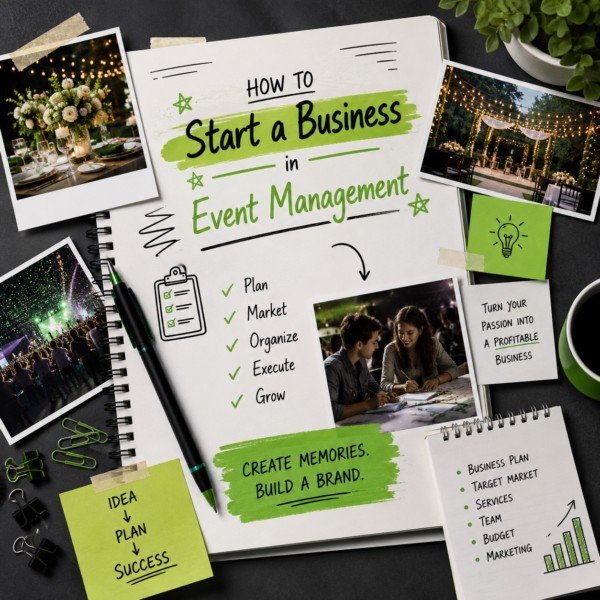
If you only want the outline of how to start event management business from scratch, it looks like this:
- Pick one niche and stay in it for the first year
- Learn budgeting, vendor negotiation and timelines
- Write a one-page plan with your pricing
- Register the business and get your licences in place
- Build a vendor network before you have clients
- Create a portfolio with small events
- Get visible on Instagram and Google
- Sign your first clients with a written agreement and an advance
The rest of this guide explains each step.
Is This Business Worth Starting?
Yes, with one condition: you must be fine working when everyone else is celebrating. Weddings, corporate launches, college fests and exhibitions happen on weekends and evenings, and more families and companies now prefer to hire someone rather than manage it themselves.
Entry is cheap. You don’t need an office, a team or a degree. You need a phone full of reliable contacts and the ability to stay calm when the DJ doesn’t show up.
Step 1: Pick One Niche
New planners love saying “we do all events.” It sounds ambitious and kills enquiries, because nobody remembers it and nobody forwards your number.
Compare:
- “We do weddings, birthdays, corporate events, concerts.”
- “We plan two-day corporate offsites for IT companies in Pune.”
The second one gets referred. Choose from weddings, corporate events, social events, exhibitions, or college and cultural events. Then check who already serves that space in your city. If ten planners fight over luxury weddings but nobody handles small corporate events professionally, that gap is your opening.
Step 2: Learn the Skills That Cost Money When You Get Them Wrong
You can learn on the job, but not these four at a client’s expense:
- Budgeting. Every event needs a buffer. Beginners quote tight and absorb a 20,000 rupee surprise from their own pocket.
- Vendor negotiation. Rates change with season, relationship and how you ask.
- Timelines. Work backwards from the event date. Decor trials, permissions and printing take longer than expected.
- Crisis handling. Something breaks at almost every event. Planners who last already have a plan B.
Assisting an established planner at 4 or 5 events teaches more than any amount of reading. A structured course helps with fundamentals, but it doesn’t replace being on the ground.
Step 3: Write a One-Page Plan for Your Event Management Business
Skip the 40-page investor document. One page you’ll actually reopen is enough. Answer these:
- What do you sell: full planning, day-of coordination, decor, or vendor management?
- Who buys it, and how do they find planners today?
- How will you charge?
- What does it cost to run each month, and how many events cover that?
Pricing example. Pricing is where most guides on how to start event management business go vague, so here is the real math. Planners usually charge a flat fee, a percentage of the event budget (commonly around 10 to 20 percent, varying by city and event size), or a margin on vendor bookings. On a 5 lakh rupee event, 15 percent is 75,000. If your monthly running cost is 40,000, two such events a month already put you ahead. Do this sum for your own city before quoting anyone.
Step 4: Register Properly
Many people delay this, and it costs them corporate clients, who won’t pay a business that can’t give an invoice.
- Structure: Sole proprietorship is the simplest start. For partners or investors, an LLP or private limited company is better (registered through the Ministry of Corporate Affairs).
- GST: For service providers, registration becomes mandatory once annual turnover crosses 20 lakh rupees (10 lakh in some special category states). Many planners register earlier because companies ask for GST invoices.
- Udyam registration: Free, online, useful later for loans and MSME benefits.
- Shops and Establishment licence: Required in many states. Check with your local body.
- Current account: Keep business and personal money separate from day one.
Permissions for the events themselves are where first-timers get caught:
- Police and local authority permission for public or large gatherings
- Fire safety clearance for certain venues and stage setups
- PPL and IPRS licences when copyrighted music is played at public or commercial events
- Excise permit if alcohol is served
- FSSAI compliance if you handle food directly instead of through a licensed caterer
Rules differ by state and sometimes by ward, so confirm with your local authority or a CA before your first big event. Once budgets grow, consider event liability insurance.
Step 5: Know Your Real Startup Cost
You need a laptop, a good phone, planning and design tools, basic branding with a simple website, and money for marketing and travel. A lean start commonly falls between 50,000 rupees and a few lakh, depending on your city and branding. Treat that as an estimate and build your own number.
The rule that saves beginners: never pay vendors from your own pocket. Take an advance from the client before you book anyone. Planners who skip this end up financing other people’s weddings.
Step 6: Build Your Vendor Network Before You Need It
Clients pay for your contacts as much as your time. You need a caterer, decorator, photographer, sound and lighting team, and a venue manager you can call at 11 PM the night before and who will actually pick up.
Start before you have a single client. Visit venues. Sit with decorators and ask how they handle last-minute changes. Keep two options in every category, because the one time your only caterer cancels will be a Saturday in wedding season. Pay vendors on time, and good vendors will prioritise you.
Step 7: How to Start an Event Management Business With No Experience
This is the real fear behind most searches. The answer is to manufacture the experience:
- Plan a relative’s birthday or anniversary at cost
- Offer to run a college fest stall, a community event or a friend’s engagement
- Volunteer at an exhibition to see how the backstage works
- Photograph everything and get a short written testimonial from every host
One small event done well, with good photos and an honest review, does more for you than a fancy website with nothing on it.
Step 8: Get Found Online and Offline
You don’t need a marketing budget. You need four things working:
- Instagram with real photos and short clips from your events, not stock images
- Google Business Profile, so people searching “event planner near me” find you
- A basic website with services, portfolio, testimonials and one clear way to contact you
- Referrals from venues and vendors, who often get asked “do you know a good planner?”
Word of mouth is still the strongest channel. One well-run event regularly brings two or three new enquiries.
Step 9: Close Your First Paying Clients
Most guides on how to start event management business stop at registration and never tell you how to get the first client. Start with your own circle. Say it plainly: “I’m now taking event bookings.” Someone will mention a cousin’s wedding within a week.
For your first two or three clients, a slightly lower rate in exchange for creative freedom and photo rights is fair. But always use a written agreement covering scope, payment schedule, cancellation terms, and what happens if the client changes the plan late. Friendly clients turn difficult two days before the event, and the agreement protects you then.
Step 10: Grow Only After the Basics Are Steady
Once you get repeat bookings and predictable cash flow, add services like styling or tech, enter a new city, hire a coordinator, or partner with hotels and corporates. Growing earlier just adds stress to a shaky base.

What Nobody Tells You
Cash flow is uneven in the first few months. Clients will want a 10 lakh rupee look on a 4 lakh budget, and you’ll have to say no politely. Weekends won’t belong to you. Something will go wrong at nearly every event. None of this is a reason to skip it. It’s a reason to start with advances, agreements and backup plans in place.
Final Thoughts
Knowing how to start an event management company is the easy part: choose a niche, plan, register, build vendors, prove yourself small. The hard part is showing up for that first event and running it well. Every established planner began with zero events. If you take one small booking seriously, you already know how to start an event management business that lasts.