
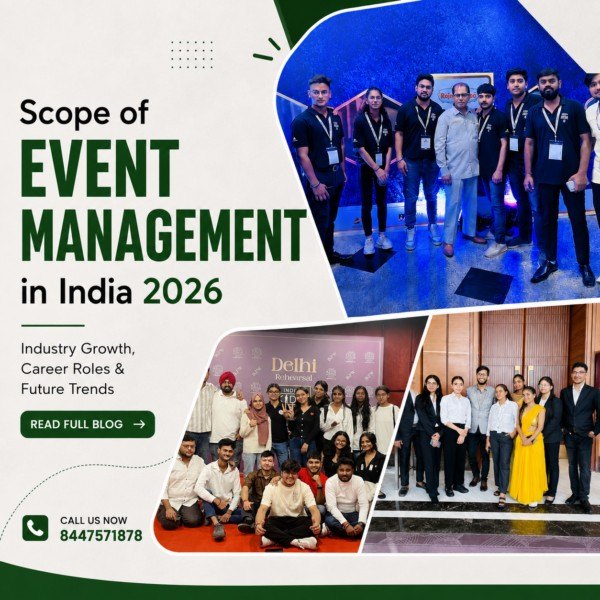
Ask ten people what event management actually pays, and you’ll get ten different answers — most of them outdated. The truth is, the scope of event management in India has changed a lot in just the last few years, and most of the old assumptions about “just decorating stages” don’t hold anymore. India’s event industry is now valued at close to ₹1.25 lakh crore, growing at a CAGR of 18-20%, and that growth is pulling in far more structured career paths than most people realise.
What the Scope of Event Management Actually Looks Like Today
The scope of event management isn’t limited to one type of work anymore. It spreads across four fairly distinct segments, each with its own skill demands and pay scale:
- Corporate events — conferences, product launches, investor summits, employee engagement days. These pay well because companies treat event budgets as marketing spend, not an afterthought.
- Weddings — still India’s biggest driver, especially with multi-day functions and destination weddings becoming standard rather than exceptional.
- Exhibitions and trade shows — a steady, less glamorous but consistently in-demand segment.
- Virtual and hybrid events — this one didn’t really exist five years ago. Now a large share of corporate events include a remote audience, which means planners who understand streaming, engagement tools, and tech setups have a real edge.
That spread is exactly why the scope of event management in India is described as “broad” — it’s not one job, it’s a cluster of related careers under one umbrella.
Career Roles Worth Knowing About
Most people entering this field start as an event coordinator or assistant, handling vendor calls, timelines, and on-ground logistics. From there, paths branch out into:
- Event manager (full project ownership, ₹3-6 LPA to start)
- Wedding planner (income scales fast with reputation, often ₹8 LPA+ once established)
- Production manager (stage, lighting, technical execution)
- Client servicing executive (the bridge between the agency and the paying client)
- Brand activation specialist (experiential marketing, often the highest-paying niche)
None of these require a specific degree stream to enter. That’s part of why this field appeals to so many 12th-pass students — arts, commerce, or science background, it genuinely doesn’t matter here.
Where Event Management Courses After 12th Fit In
This is usually the first real decision point. Event management courses after 12th typically come in three formats — short certificate programs, diploma courses, and full degree options. A diploma in event management after 12th is probably the most balanced choice for most students: shorter than a three-year degree, but detailed enough to actually cover budgeting, vendor negotiation, and live execution — not just theory.
What matters more than the format, honestly, is how much of the course is hands-on. A diploma in event management after 12th that includes live event exposure — actual weddings, conferences, or exhibitions — teaches things no classroom lecture can. At Event University in Connaught Place, for instance, the diploma-level programs run over 6 to 9 months and are built around 80% practical learning, with students working directly on real weddings, corporate conferences, and exhibitions rather than case studies on paper.
Where the Industry Is Headed Next
A few shifts are worth watching. Sustainability is becoming a client expectation, not a bonus — planners who can execute low-waste events are getting preferred. Tech integration (AR/VR setups, hybrid streaming) is moving from “nice to have” to a standard ask for corporate clients. And brands are investing more in experiential marketing than traditional advertising, which is quietly creating some of the best-paying roles in the industry.
Quick Questions People Actually Ask
Is event management a good career after 12th? For students who don’t want to wait three years before earning, yes — short diploma routes let you start assisting on real events within months, and pay grows with experience rather than tenure.
What’s the difference between a certificate and a diploma course? A certificate course covers basics fast, usually in weeks. A diploma in event management after 12th goes deeper — budgeting, vendor negotiation, live project work — and generally carries more weight with employers.
Do I need to know a specific stream to join? No. Event management courses after 12th accept students from Arts, Commerce, and Science equally — this is one of the few career paths where stream genuinely doesn’t matter.
The Honest Takeaway
If you’re weighing whether to pursue this after 12th, the scope of event management in India isn’t hype — the numbers back it up, and the roles are genuinely varied enough that almost any personality type can find a fit, whether that’s client-facing, creative, or purely operational. The part that actually determines your income isn’t the course name on your certificate — it’s how much real event floor time you get before you start applying for jobs.